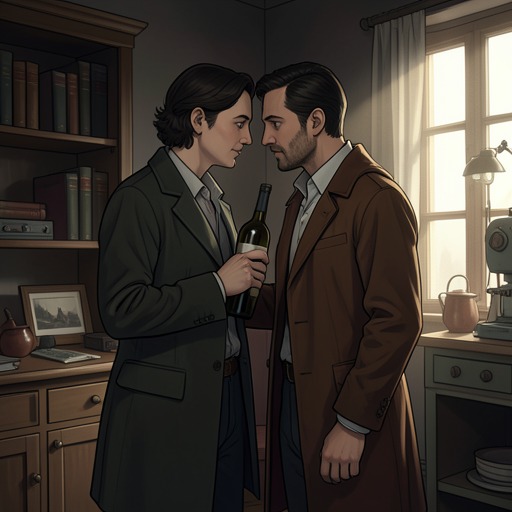
Virginia and Lacke’s love as she faces infection
Let the Right One InVirginia and Lacke’s love as she faces infection is tested when Virginia reveals that she has become a vampire and asks Lacke to destroy her heart. Their scenes move from a disquieting encounter in which Virginia’s gaze seems emptied of recognition to a hospital bedside where she entrusts him with the truth and the decision she cannot make alone. Lacke’s response is neither a simple promise nor a clean refusal: he resists the course before them, remains physically close, and answers the crisis with an imagined future for the two of them.
A relationship under strain
Lacke’s connection to Virginia appears amid the unsettled circumstances around her. He lets a telephone ring ten times before hanging up. Gosta, sitting on the couch and stroking a striped orange cat, asks whether no one is home; Lacke answers irritably that someone is, and asks whether Gosta did not hear them talking. This small exchange offers no explanation for the call, but it places Lacke in a domestic scene shaped by waiting, interruption, and tension rather than by a settled conversation between lovers.
When Virginia turns toward him, Lacke flinches. Her eyes seem empty, as though whatever made her recognizably Virginia has been removed, leaving a fixed, expressionless stare. She releases Gosta and moves to the door, tries the handle, and turns the lock. Lacke grabs her and drags her away. The scene gives their relationship a physical urgency: Virginia is trying to leave, while Lacke intervenes. It does not explain her immediate purpose, but her altered gaze makes the encounter feel like a rupture in the person he expects to meet. His recognition of her is now confronted by an appearance that seems to deny it.
The confession and its demand
At the hospital, silence takes over before the most difficult words are spoken. Virginia and Lacke look at one another, and the scene presents their sickroom situation as one in which ordinary talk has become inadequate. Virginia asks him for help. Lacke answers, “I’ll do anything.” Her reply changes what that promise requires: “I am a vampire.” The confession is not merely a disclosure about her condition. Virginia tells him that she went to Gosta intending to kill him and drink his blood, and that she would have done so if events had not intervened. She insists that Lacke understand both the danger and the intention behind it.
Lacke first reacts with disbelief, saying “No!” He tries to break the stillness by massaging his neck, but Virginia speaks in a controlled voice and makes the truth harder to evade. When he asks what she wants him to do, she asks, “I want you to … destroy my heart.” The request turns intimacy into an unbearable responsibility: she is asking the person she loves to take action against her, not merely to comfort her. Lacke’s promise to do anything meets its limit here. The exchange records the request, but not an immediate agreement to carry it out.
Resistance, touch, and an imagined future
Lacke does not simply proceed with what Virginia has asked. He says, “No, no, no. You can forget about it in that case. Have to think of something better.” The conversation’s precise preceding proposal is not repeated in this passage, but his words establish that he rejects the course as it has been put to him and wants another possibility. Virginia responds with a quiet “OK.” The scene does not settle what they will do; instead, it shifts from the argument to the contact between them.
Lacke takes Virginia’s hand. He finds it strangely restrained and too large for both his hands to encircle, yet it is warm, and it squeezes his. He strokes her cheek and asks whether he should undo the restraints. Virginia says no, warning that it can come back. The touch is tender, but it does not erase the danger she has described. Her warmth and answering pressure coexist with restraint and the possibility of a return; their closeness offers neither a cure nor certainty.
Still holding her hand, Lacke begins to tell Virginia everything: about the stamps, the lion, Norway, and the money. He describes the little cottage they were going to buy, its red Falu paint, and the garden they would make, with flowers and a small table in a shady patio. This imagined domestic life is concrete and particular, not an abstract assurance that everything will be well. It gives their possible future recognizable details even as the hospital scene makes that future uncertain. Virginia listens in tears, which run down her cheeks without sobbing. The passage leaves the meaning of those tears open, poised between sadness and joy.
The unspoken answer
Lacke eventually falls silent, and Virginia squeezes his hand hard. He goes into the corridor, persuades and pleads his way to an extra cot, positions it directly beside her bed, turns out the light, and climbs in. In the dark, he feels for her hand. His actions make his answer practical rather than declarative: he arranges to remain beside her through the night, even though the conflict over what she asked him to do has not been resolved in the scene.
After a long time, Virginia tells him, “Lacke. I love you.” Lacke does not reply. The silence is not described as rejection: her words become, in the narrative image, a large red blanket that settles over him and keeps him warm all night. That image gives the relationship its final emphasis in these moments. Virginia has asked for a terrible act, and Lacke has not answered her declaration in words; what the passage shows instead is his continued presence, their joined hands, and the warmth he receives from what she says.